Executive Summary and Group Overview
NightSpire is a financially motivated double-extortion ransomware operation that emerged in February 2025. It is assessed with high confidence as a rebrand and capability escalation of the earlier "Rbfs" extortion group, driven by the same core operators. Within approximately 15 months of emergence, the group had claimed 259 victims across 30 or more countries and announced a formal Ransomware-as-a-Service (RaaS) affiliate program in April 2026. Despite rapid growth in victim volume, the group retains markers of operational immaturity: poor OPSEC, erratic extortion behavior, and infrastructure that leaves identifiable forensic fingerprints.
Geographic indicators from infrastructure analysis suggest an India-linked operator nexus with probable Chinese-speaking involvement, based on a WinSCP exfiltration server IP assigned to Kerala Agricultural University's academic network block and Chinese internet culture markers (tilde greeting, operator handle "cuteliyuan" containing the common Chinese given name "liyuan"). Spanish open-source reporting characterized the group as likely Russian or Eastern European, but this assessment predates the Barracuda infrastructure analysis and is in tension with it. No formal government attribution has been published as of May 2026.
| Attribute | Detail |
|---|---|
| Status | Active and growing; formal RaaS transition announced April 2026 |
| Predecessor | Rbfs (data-only extortion, early 2025); shared operators xdragon128 and cuteliyuan |
| Tracking designations | No formal tracking designation from CrowdStrike, Secureworks, Unit 42, Mandiant, Recorded Future, or Microsoft as of May 2026 (INTELLIGENCE GAP). SonicWall signature: GAV: NightSpire.RSM (Trojan). AhnLab V3: Ransomware/Win.Nightspire. AttackIQ and Cyble track as NightSpire. |
| Operational model | Closed crew (Feb to mid-2025), transitioning to RaaS affiliate model (2025 to present) |
| Extortion mechanic | Double extortion: exfiltration followed by encryption; countdown DLS; secondary data sale to third parties if payment refused |
| Primary IAV | CVE-2024-55591 (FortiOS/FortiProxy authentication bypass); also RDP brute-force, phishing, credential stuffing |
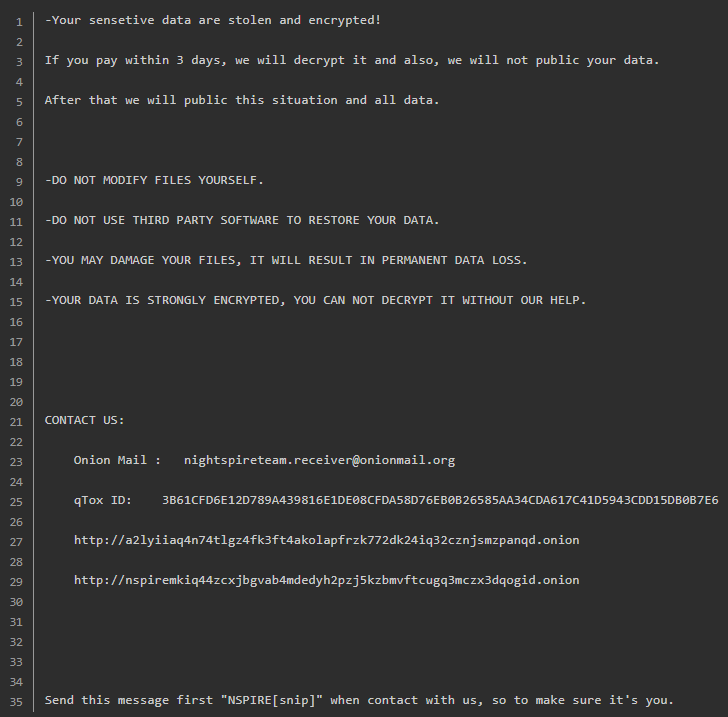
| Encryptor | Go-compiled PE, AES-256-CBC per-file, RSA-2048 key wrap; .nspire extension; readme.txt ransom note |
| Victim count | 259+ as of May 1, 2026 (11 in Mar 2025, 45+ by May 2025, 200+ by late 2025, 259 by May 2026) |
| Assessed geography | India-linked IP infrastructure, probable Chinese-speaking operator (cuteliyuan), East Asian cultural markers; no formal state attribution (CREDIBLE inference, medium confidence) |
| Decryptor available | No public decryptor. Not listed on No More Ransom as of May 2026. |

Lineage and Organizational Heritage
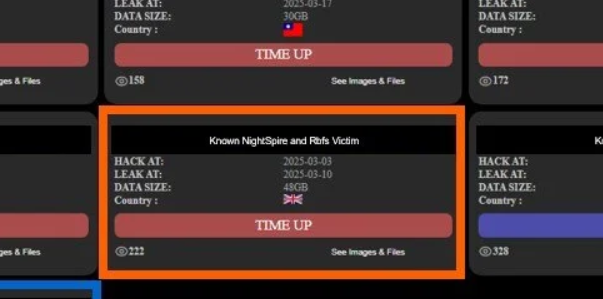
S-RM Intelligence assessed in March 2025 that it is "highly likely" NightSpire operators are associated with the Rbfs ransomware group. Barracuda Networks (May 2026) and multiple open-source outlets corroborate this assessment through independent observation of the same three evidentiary pillars. ASEC (August 2025) characterized the rebrand question as "unclear," but did not dispute the Rbfs evidence directly. No major TI vendor (CrowdStrike, Secureworks, Unit 42, Mandiant, Recorded Future) has published a formal connected-cluster assessment as of May 2026, leaving the Rbfs connection at credible but not universally accepted.
Barracuda's reporting traces xdragon128 further back into 2024, prior to Rbfs activity. In late 2024, xdragon128 was observed collaborating with "Paranodeus" in the DarkAssault and DeepWing Telegram channels to build and distribute the Python-based Parano toolset. During this same period, xdragon128 appeared in hacktivist-adjacent channels linked to CyberVolk, a pro-Russian hacktivist group. Multiple secondary sources note the possible equation of "Paranodeus" and "xdragon128" as the same individual, though Barracuda explicitly states it does not have evidence to confirm this.
The Parano toolset connection is notable because the NightSpire Go-based encryptor represents a deliberate departure from Python-based tooling, suggesting new developer involvement rather than simple reuse. The extended lineage runs through shared human operators, not shared code.
| Dimension | Rbfs | NightSpire |
|---|---|---|
| Extortion model | Data theft and extortion only (no encryption) | Double extortion: exfiltration plus full encryption |
| Encryptor language | None documented; Parano toolset was Python-based | Go (Golang) compiled PE binary |
| Dedicated leak site | No dedicated DLS; forum and Telegram posts only | Full Tor-based DLS with countdown timers, victim pages, free data samples |
| Affiliate model | No affiliate program | Negotiator recruitment (20% share) 2025; public RaaS affiliate program announced April 2026 |
| OPSEC | Low (Telegram, identifiable operators) | Low-to-moderate (Gmail comms, identifiable hostname, exposed directory listings in early phase) |
The transition from Rbfs to NightSpire represents a capability escalation rather than a simple rebrand: new encryptor (likely sourced from a developer not previously associated with xdragon128), full DLS infrastructure, and a structured double-extortion playbook. The core operators provide organizational continuity; the toolset and tradecraft represent an upward capability step.
No major intelligence vendor had published a formal, branded tracking designation specifically for NightSpire as of May 2026. The confirmed tracking designations and signatures are limited to:
- SonicWall Capture Labs: GAV: NightSpire.RSM (Trojan)
- AhnLab ASEC (V3): Ransomware/Win.Nightspire.C5769860 (2025.06.12.02) and Ransomware/Win.Nightspire.C5775165 (2025.07.01.03)
- AttackIQ: Attack graph content modeled under "NightSpire ransomware" (April 2026)
- Cyble: Publishes threat actor profile as NightSpire Ransomware Group
- Broadcom Security Center: Protection bulletin issued for NightSpire Ransomware
The absence of a CrowdStrike adversary name (typically in the [ANIMAL] SPIDER format), a Secureworks GOLD designation, a Unit 42 tracking label, a Mandiant UNC number, or a Microsoft Storm designation is itself an intelligence gap, reflecting either the group's relative recency or its current tier positioning below the threshold for formal major-vendor classification.
Operational Model
| Period | Model | Evidence | Confidence |
|---|---|---|---|
| Feb to mid-2025 | Closed crew, end-to-end operator control | Halcyon (July 2025): "no public RaaS, no affiliate program, it's a closed shop" | CONFIRMED for this period |
| Mid to late 2025 | Hybrid: limited external recruitment | BreachForums post by xdragon128 recruiting a negotiation specialist at 20% profit share; HivePro (Sept 2025): "RaaS model" | CREDIBLE |
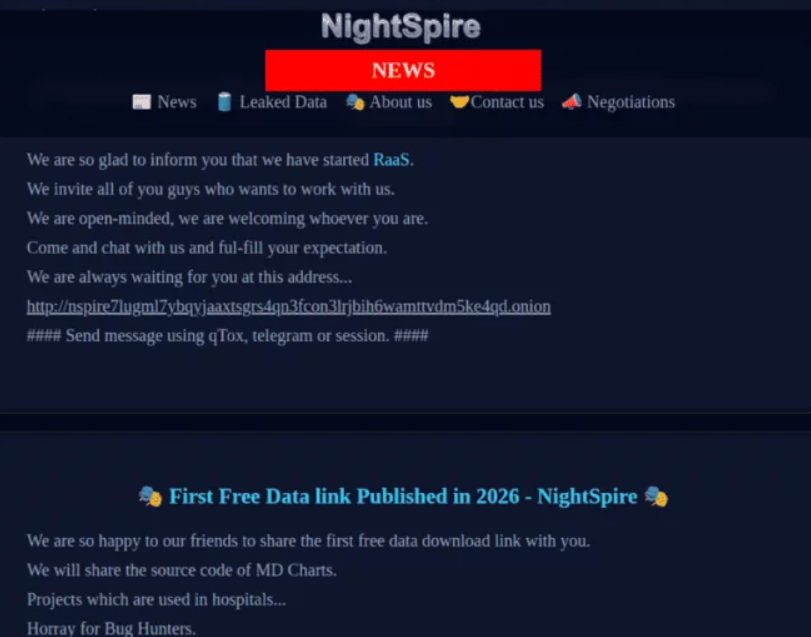
| April 2026 onward | Formal affiliate RaaS offering | DLS screenshots showing public affiliate invitation; AttackIQ (April 2026) states "launched a RaaS program" | CONFIRMED |
The progression is consistent with the growth pattern of other mid-tier operations: initial closed-crew testing, then limited function outsourcing (negotiators), then a formal affiliate layer. If the RaaS model matures, TTP variance across incidents will likely increase significantly, complicating attribution and remediation scoping.
- Negotiators: 20% of proceeds, documented from a BreachForums recruitment post (S-RM, March 2025).
- Intrusion affiliates (if any): No confirmed split model published in open sources. No "must not be from CIS countries" exclusion rule documented, unlike several established Russian-language crews. This is an intelligence gap.
- Vetting criteria: No detail on technical requirements or vetting process for affiliates is available in open-source reporting as of May 2026.
NightSpire's negotiation posture is characterized by aggressive pressure, short deadlines, and willingness to escalate rapidly. Key documented behaviors:
- Deadline compression: Payment deadlines as short as 48 hours from ransom note delivery, substantially shorter than the week-plus standard used by more professionalized operations (S-RM).
- Multi-channel pressure: Operators use negotiation portals, email (early period: Gmail; later: ProtonMail and OnionMail), Telegram, and in some cases direct employee contact to sustain pressure from multiple angles simultaneously.
- Escalation triggers: When negotiations stall, NightSpire has published portions of stolen data, shared excerpts of prior communications, and threatened secondary data sale to other threat actors.
- Secondary market threat: NightSpire explicitly threatens to sell stolen data to third parties if the primary victim refuses payment, documented on DLS listings (S-RM).
- Unprofessional tone: S-RM and ASEC both note highly threatening and psychologically aggressive language as a consistent stylistic marker. Negotiation chat logs archived by ransomware.live show willingness to escalate immediately and leak selected data when victims resist.
NightSpire's extortion model follows a staged structure designed to maintain maximum leverage throughout the negotiation cycle:
| Period | Channels | OPSEC Assessment |
|---|---|---|
| Early 2025 | Gmail (documented), early Tor portals | Very poor; Gmail use risks account suspension mid-negotiation and attribution via account metadata |
| Mid to late 2025 | ProtonMail, OnionMail, Telegram handles, dedicated Tor portals | Moderate; standard operational security for ransomware groups |
| 2026 | Tor negotiation portals (victim-specific IDs), ProtonMail | Moderate; consistent with mature double-extortion operations |
Technical Capabilities
| Vector | CVE / Method | Notes | Confidence |
|---|---|---|---|
| FortiOS / FortiProxy exploitation | CVE-2024-55591 | Authentication bypass allowing unauthenticated attacker to gain super-admin privileges via crafted Node.js WebSocket requests. Affects FortiOS 7.0.0-7.0.16 and FortiProxy 7.0.0-7.0.19 / 7.2.0-7.2.12. Fortinet disclosed January 14, 2025; exploitation observed from November 2024. Verified against NVD entry. | CONFIRMED |
| RDP brute-force / credential stuffing | N/A | Credential-based attacks against exposed RDP services. Huntress incident (March 2026): threat actor accessed endpoint via RDP prior to additional tooling deployment. | CONFIRMED |
| Phishing | N/A | Documented by Barracuda and AttackIQ; also includes MFA fatigue attacks and RMM platform abuse. | CREDIBLE |
| VPN perimeter exploitation (general) | Multiple | Not limited to Fortinet; vulnerable VPN and perimeter services more broadly observed as access vectors. | CREDIBLE |
| Category | Tools | Purpose |
|---|---|---|
| LOLBins / native | PowerShell, WMI, PsExec, Conhost | Command execution, lateral movement, defense evasion |
| Discovery | Advanced IP Scanner, Everything.exe | Network mapping, file search and targeting of financial records, customer data, internal communications |
| Credential harvesting | Mimikatz | LSASS memory extraction: passwords, NTLM hashes, Kerberos tickets; domain admin escalation |
| Remote access / persistence | AnyDesk, Chrome Remote Desktop | Persistent hands-on-keyboard access; Chrome Remote Desktop account email prince1990905@gmail.com documented in March 2026 Huntress incident |
| Data staging | 7-Zip | Encrypted archive creation for exfiltration staging |
| Exfiltration | MEGASync / MEGACmd, WinSCP, Rclone | Transfer to attacker-controlled cloud or server infrastructure |
| Other imported tools | VMware Workstation, WPS Office | Operational convenience; WPS Office (Kingsoft, Chinese company) noted as potentially culturally significant given Chinese-speaking operator indicators |
| Parameter | Detail | Source |
|---|---|---|
| Encryptor language | Go (Golang), compiled PE binary | SonicWall, AhnLab ASEC |
| Symmetric cipher | AES-256-CBC (per-file key) | AttackIQ, ASEC (encrypted file structure confirmed: AES key appended at end of file, RSA-encrypted) |
| Key protection | RSA-2048 public key wraps per-file AES key | AttackIQ, ASEC (Figure 3: encrypted file structure) |
| Extension | .nspire | CONFIRMED (multiple sources) |
| Ransom note filename | readme.txt (2025); _nightspire_readme.txt (Dec 2025); [nspire_msg].txt (Mar 2026) | Huntress: filenames evolved between incidents |
| Block encryption targets | iso, vhdx, vmdk, zip, vib, bak, mdf, flt, ldf: 1 MB block encryption for speed | ASEC (confirmed from reverse engineering); partial overlap with AttackIQ list |
| Full encryption | All other file extensions | ASEC |
| VSS deletion | None documented | ASEC: Volume Shadow Copy deletion not observed |
| OneDrive behavior | OneDrive-synced files encrypted without changing icons or file extensions; corruption not visually apparent until file open attempt | SonicWall (documented as an advanced operational capability for detection delay) |
| Desktop background | No change documented | ASEC |
| Decryptor availability | None. Not listed on No More Ransom. No cryptographic weakness publicly disclosed. | Multiple sources; verified via nomoreransom.org |
Open sources do not document any hard-coded checks for Russian, Ukrainian, or other CIS keyboard layouts or system locales in the NightSpire binary. No analyst has confirmed that the encryptor aborts on CIS-region systems, unlike some established Russian-aligned crews. The absence of a CIS exclusion, combined with the India/China attribution indicators, is weakly consistent with a non-Russian operator profile. However, this should be treated as an outstanding collection requirement rather than a confident conclusion.
| Hash (SHA-256) | Filename | Incident Date |
|---|---|---|
| bde50a42efc079edde1a314243ad339db2d42e343fbbcd39117803b0f5960355 | enc.exe | December 2, 2025 |
| ad67031e2ca68764fe1a7d6632c02b02a299d59efb920710011a9a2ccf4399b7 | enc.exe | March 25, 2026 |
The two hashes differ, confirming that the encryptor binary was modified between December 2025 and March 2026. This is consistent with either active development or affiliate-specific builds.
Public coverage centers entirely on Windows environments. SonicWall's analysis documents impact across local paths and OneDrive-synchronized content. No confirmed Linux or ESXi/hypervisor-specific variant has been documented in open sources as of May 2026. The absence of a dedicated Linux/ESXi build would represent a capability ceiling relative to top-tier groups (LockBit, BlackCat, Akira) that routinely target VMware ESXi hosts. This should be treated as a collection requirement.
Financial Infrastructure
Ransomware notes and DLS commentary strongly imply standard cryptocurrency payments. The specific cryptocurrency type (Bitcoin, Monero, or other) is not explicitly quoted in the open-source reporting reviewed. No wallet addresses have been publicly linked to NightSpire incidents in available reporting. This absence of explicit crypto payment detail is itself analytically notable for a group with 259 claimed victims.
No published blockchain analysis from Chainalysis, TRM Labs, Elliptic, or any other on-chain forensics firm has been cited in connection with NightSpire as of May 2026. This is a major intelligence gap. Consequently, there is no current mapping of wallet clusters, layering patterns, mixer or tumbler use, cross-chain bridge activity, or cash-out exchange identification in publicly available sources.
No OFAC-listed wallet addresses or specific sanctions designations (U.S., EU, or UK) have been publicly associated with NightSpire as of May 2026. No formal government financial attribution has been published. The group does not appear on any publicly available OFAC SDN list entry.
Victim Profile and Targeting
The growth rate from 11 to 259 victims in approximately 14 months represents one of the faster documented expansion trajectories for an emerging ransomware group. The formal RaaS announcement in April 2026 is expected to accelerate this rate further, introducing greater TTP variance in the process.
| Sector | Notes |
|---|---|
| Manufacturing | Disproportionately represented, approximately 36% of early 2025 cases (S-RM); chemical and industrial manufacturing documented in Japan and Poland |
| Technology and IT | Software providers and IT services targeted across multiple geographies |
| Healthcare | Documented; no explicit healthcare ban observed unlike some other groups |
| Financial services | Documented across Taiwan, UK, and other markets |
| Retail and wholesale | Spanish hardware distributor Bresme (a named publicly reported victim); US retail also documented |
| Logistics and maritime | Maritime industry in Thailand documented (ASEC) |
| Professional services | Accounting services (UK), business services (Hong Kong) |
| Construction | Construction industry in Hong Kong documented |
| Government / public sector | Some public-sector entities documented (AttackIQ); Municipality of Ardon (France) claimed |
The group is broadly opportunistic. Sector representation reflects access opportunity (primarily exposed perimeter devices running vulnerable Fortinet software) rather than deliberate sector targeting. No documented sector exclusions.
Victims span more than 30 countries. Confirmed geographies with documented cases include: United States, Spain, Japan, Thailand, United Kingdom, China, Poland, Hong Kong, Taiwan, South Korea (ASEC reporting), and France (Municipality of Ardon). The breadth reflects opportunistic global targeting rather than regional focus. No CIS-country exclusion has been documented.
S-RM's early 2025 sample found that 73% of victims had fewer than 1,000 employees, confirming a primary focus on small and mid-sized organizations with less mature security controls and reduced incident response capacity. AttackIQ corroborates this as a defining characteristic. NightSpire has not yet achieved a marquee enterprise victim list comparable to LockBit or BlackCat; named victims (Bresme, Ardon) are mid-market rather than Fortune-level targets.
No explicit sector bans, country exclusions, or size thresholds are documented in NightSpire's public communications or observed behavior. The group does not appear to maintain the kind of published targeting policy used by some more "professionalized" Russian-aligned operations (e.g., "no hospitals, no critical national infrastructure"). Healthcare entities have been targeted. The absence of a CIS exclusion is noted but its meaning is ambiguous given the uncertain geography of the operators themselves.
Law Enforcement and Regulatory Response
As of May 1, 2026, there are no public indictments, criminal charges, arrests, or named suspects tied specifically to NightSpire in U.S. or European court records, law enforcement advisories, or Europol/FBI press releases. No CISA/FBI joint advisory focused specifically on NightSpire has been published. No successful infrastructure seizure or DLS takedown has been reported. This distinguishes NightSpire clearly from more established groups such as LockBit, BlackCat/ALPHV, and Hive, which have all been subjects of major multinational LE operations.
- AhnLab ASEC (August 2025): Published an advisory warning South Korean organizations about NightSpire ransomware following domestic damage cases. Vendor-driven, not a government bulletin.
- Broadcom Security Center: Protection bulletin published for NightSpire, covering detection signatures.
- SonicWall Capture Labs: Published technical analysis with signature coverage (GAV: NightSpire.RSM).
- AttackIQ (April 2026): Published attack graph emulation for NightSpire to support security control validation.
- Barracuda Networks (May 2026): Comprehensive threat profile including infrastructure analysis and operator attribution indicators.
No CISA alert, FBI Flash, or Europol advisory specifically addressing NightSpire has been published as of May 2026. This absence reflects the group's current mid-tier status relative to the threshold for government-level advisory publication.
No OFAC designations, EU sanctions, or UK sanctions specifically naming NightSpire, its infrastructure, or its identified operators (xdragon128, cuteliyuan) have been reported. The operator handles and the single documented infrastructure IP (14.139.185.60) have not appeared in any publicly known sanctions action.
S-RM (March 2025) noted that NightSpire's leak-site tech stack leaves recognizable fingerprints that could support targeted law enforcement takedown action. The group's early OPSEC failures (Gmail use, exposed directory listings, identifiable server hostname) provide more forensic footholds than a mature operation would leave. However, no evidence of any LE disruption attempt has been publicly disclosed as of May 2026.
Attribution and State Nexus
NightSpire is assessed as a financially motivated cybercriminal enterprise. All reviewed sources treat the group as criminal rather than state-directed. The geographic attribution picture is contested, with evidence pointing toward South or East Asia rather than the Russia/Eastern Europe origin suggested in earlier Spanish-language reporting. No formal government attribution has been published by any national intelligence or law enforcement agency as of May 2026.
| Indicator | Points Toward | Source | Confidence |
|---|---|---|---|
| WinSCP exfiltration server IP 14.139.185.60 | India (Kerala Agricultural University, National Knowledge Network block) | Barracuda (May 2026), S-RM (March 2025) | CONFIRMED as IP assignment; likely compromised host, not necessarily operator location |
| Operator handle "cuteliyuan" containing "liyuan" | Chinese-speaking individual ("liyuan" is a common Chinese given name) | Barracuda (May 2026) | CREDIBLE |
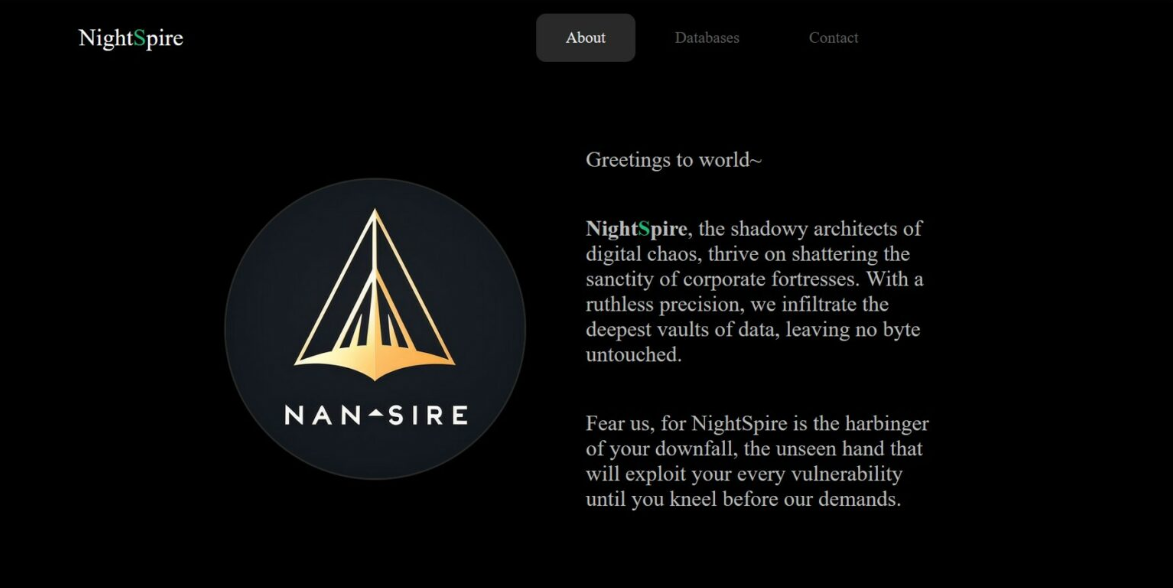
| Trailing tilde (~) in DLS greeting "Greetings to world~" | East Asian internet culture, particularly Chinese | Barracuda, citing academic research on East Asian CMC markers | CREDIBLE (documented cultural marker, not definitive) |
| WPS Office installation by threat actor | Chinese-affiliated (Kingsoft, Chinese company) | Huntress (April 2026) | ANALYST INFERENCE |
| xdragon128 CyberVolk association | Pro-Russian hacktivist-adjacent community | Barracuda, Cyfirma | CREDIBLE for prior association, weak inference for current alignment |
| Spanish intelligence/media characterization | Russia or Eastern Europe | Escudodigital (May 2026) | CREDIBLE as secondary inference, predates Barracuda infrastructure analysis |
| No CIS exclusion in encryptor | Non-Russian operator (weakly) | Analyst observation from available reverse engineering reports | ANALYST INFERENCE |
| Handle | Role | Prior Activity | Notes |
|---|---|---|---|
| xdragon128 (alias xdragon333) | Primary public-facing operator; Rbfs and NightSpire promotion, DLS management | 2024: Parano toolset development with Paranodeus in DarkAssault/DeepWing Telegram; CyberVolk-adjacent channels | Naming convention (dragon + number) consistent with gamer culture. Hostname XDRAGON-SERVER1 provides direct infrastructure link. |
| cuteliyuan | Secondary operator; promoted Rbfs victim data on Telegram before NightSpire emergence | Rbfs Telegram activity (early 2025) | Handle contains "liyuan," a common Chinese given name. Assessed as probable Chinese-speaking individual. |
No real-name identities for either operator have been publicly confirmed. No passport, national ID, or physical address data is available in open sources.
- No direct state linkage documented. No reliable reporting describes direct ties to any state intelligence or security service (Indian, Chinese, Russian, or other).
- No state cut-out behavior observed. NightSpire has not been used in targeted operations against specific government entities or strategic adversaries in a pattern consistent with state-directed use.
- CyberVolk association is weak evidence at best. xdragon128's prior presence in CyberVolk-adjacent channels does not establish a current operational relationship with any state actor. CyberVolk itself is assessed as a financially motivated hacktivist group with pro-Russian sympathies, not a formal state instrument.
- Safe harbor inference: If the operators are China-based, the informal "safe harbor" dynamic that characterizes Russian-based ransomware (operational tolerance in exchange for avoiding domestic targets) would not apply in the same form. Chinese authorities have shown greater willingness than Russian authorities to prosecute domestic cybercriminals in some contexts, though toleration of criminal operations targeting foreign entities has also been documented.
Bottom line: NightSpire is best assessed as a financially motivated criminal operation with no confirmed state nexus (medium confidence). The geographic attribution is ambiguous. The group's small scale, poor OPSEC, and criminal ecosystem connections do not fit a state-controlled operational profile.
Trajectory Assessment
| Group / Actor | Connection Type | Confidence (Anchor) | Confidence (Extension) | Vendor Coverage |
|---|---|---|---|---|
| Rbfs | Direct predecessor; shared operators, victims, and infrastructure | CREDIBLE (multi-source: S-RM, Barracuda, screenshot evidence) | N/A (direct connection, not extended inference) | S-RM, Barracuda, Escudodigital; NOT formally assessed by CrowdStrike, Secureworks, Unit 42, Mandiant, or Recorded Future as of May 2026 |
| Paranodeus | xdragon128 collaboration on Parano toolset (2024) | CREDIBLE (Cyfirma/S-RM) | ANALYST INFERENCE (no shared code or infrastructure with NightSpire; Parano toolset not used in NightSpire operations) | Cyfirma; not formally assessed by major TI vendors |
| CyberVolk | xdragon128 present in associated Telegram channels (2024) | CREDIBLE (channel co-presence) | ANALYST INFERENCE (no operational overlap with NightSpire activity documented) | SentinelOne (CyberVolk profiling); not linked to NightSpire by any major vendor |
No strong open-source evidence places specific affiliates known from other major RaaS ecosystems (LockBit, BlackCat, Cl0p) within NightSpire's operational network. Shared tool usage (Fortinet exploitation, LOLBins, MEGASync) overlaps superficially with many groups but does not indicate developer or personnel sharing beyond xdragon128/cuteliyuan continuity.
| Dimension | Early 2025 | Mid-2026 | Direction |
|---|---|---|---|
| Encryptor capability | No encryption (Rbfs); early Go build | Mature AES-256/RSA-2048 Go build with OneDrive-aware evasion | Positive (improving) |
| Victim volume | 11 (March 2025) | 259 (May 2026) | Positive (rapid growth) |
| Affiliate structure | Closed crew | Formal RaaS program announced | Positive (scaling) |
| Communication OPSEC | Gmail, exposed directories, identifiable hostname | ProtonMail, Tor portals | Positive (improving) |
| Extortion sophistication | Single-channel, basic deadlines | Multi-channel, staged leaks, secondary data sale | Positive (improving) |
| LE attention | None | None | Flat (no disruption pressure) |
| OPSEC overall | Very poor (GMAIL, XDRAGON-SERVER1) | Low-to-moderate (infrastructure fingerprints remain) | Marginal improvement |
- No shutdown signals: The April 2026 RaaS announcement points explicitly toward expansion, not exit.
- No internal leak/dispute signals: No equivalent of the Conti internal chats leak or Black Basta dispute logs has appeared for NightSpire.
- No post-seizure rebranding pattern: The Rbfs-to-NightSpire transition appears to have been a voluntary capability upgrade rather than a post-seizure pivot. No law enforcement disruption preceded it.
- Infrastructure exposure risk: S-RM's observation that DLS tech-stack fingerprints remain identifiable means there is a latent takedown vector, but no evidence it is being actively pursued.
NightSpire is on a clear upward trajectory in terms of victim volume, capability, and organizational structure. The most likely near-term development is affiliate-driven diversification of TTPs, making incident clustering more difficult and attribution less reliable. The group's OPSEC remains below the level that would make a law enforcement disruption technically difficult. If the RaaS affiliate pool expands rapidly, both the victim count and the TTP variance will accelerate. The most analytically significant open question is whether the group's geographic and personnel indicators will prompt action from non-Western law enforcement (India, China), which historically have taken action against cybercriminals when international pressure or reputational cost is sufficient.